 |
| photo by C. Nolan Huizenga, on Flickr |
In Little Bethlehem (Winds Through the Olive Trees)
traditional, 16th century
Winds through the olive trees,
Softly did blow.
'Round little Bethlehem,
Long, long ago.
Sheep on the hillsides lay
Whiter than snow,
Shepherds were watching them,
Long, long ago.
Then from the starry skies
Angels bent low,
Singing their songs of joy;
Long, long ago.
For, in a manger bed
Cradled we know,
Christ came to Bethlehem
Long, long ago.
 |
| "Fall Sun" by maxine1313, on Flickr |
Hebrews 1:1-4
Long ago God spoke to our ancestors in many and various ways by the prophets, but in these last days he has spoken to us by a Son, whom he appointed heir of all things, through whom he also created the worlds. He is the reflection of God’s glory and the exact imprint of God’s very being, and he sustains all things by his powerful word. When he had made purification for sins, he sat down at the right hand of the Majesty on high, having become as much superior to angels as the name he has inherited is more excellent than theirs.
John 1:1-14
In the beginning was the Word, and the Word was with God, and the Word was God. He was in the beginning with God. All things came into being through him, and without him not one thing came into being. What has come into being in him was life, and the life was the light of all people. The light shines in the darkness, and the darkness did not overcome it.
There was a man sent from God, whose name was John. He came as a witness to testify to the light, so that all might believe through him. He himself was not the light, but he came to testify to the light. The true light, which enlightens everyone, was coming into the world.
He was in the world, and the world came into being through him; yet the world did not know him. He came to what was his own, and his own people did not accept him. But to all who received him, who believed in his name, he gave power to become children of God, who were born, not of blood or of the will of the flesh or of the will of man, but of God.
And the Word became flesh and lived among us, and we have seen his glory, the glory as of a father’s only son, full of grace and truth.
--
As the first birds start to sing their song over Bethlehem, Mary opens her eyes. Joseph is not yet stirring, and the newborn Jesus is still sleeping, tired from all the work of entering the world. The first ribbons of daylight creep through the cracks in the ceiling, and in the rising light of dawn, Mary feels all of the anxieties of the night lift away.
The darkness had been full of hard things: a hard journey over the hard ground; the sharp pains of labor; the rough disappointment of hearing that there was no room; the sting of fear that comes with being vulnerable, homesick, and in pain in the deep middle of the night, when the shadows are darkest and when the world seems most uncertain.
But it is morning now. The morning is still and clear. The rising of the herald star is now eclipsed by the rising of the sun; light upon light. There is a softness here, a hush, a waking moment to ponder all the wonders of the night. For the first time, Mary can see every detail of her baby boy's face; each soft curve of his cheek, each eyelash as it flutters, every wisp of downy hair.
What has come into being with him was life, and the life is the light of all people. He is the reflection of God’s glory and the exact imprint of God’s very being. The light shines in the darkness, and the darkness did not overcome it.
Light was the first miracle of all creation - in the beginning, when the world was a formless void and the Spirit of the Lord hovered over the face of the waters, God spoke into the darkness and said, "Let there be light." And there was light. And it was good.
We repeat this miracle every morning - from darkness, light rises with each new dawn. Today, once again, the sun has risen, in hazy streaks of light that tumble over the bluffs and reawaken the sleeping earth from its nighttime dreaming.
But this morning, the light seems different, doesn't it? Somehow it is clearer, holier, filled with the shimmer of deep miracles; in the light, we get our first real look at the tiny, red, wrinkled face of the newborn Jesus. I'm not sure whether it is the gravity of this baby's divinity that makes our hearts soften, or whether it is merely the effect of being in the presence of an impossibly tiny, fragile, untried, adorable baby. But either way, don't you feel your heart soften just a little when you, like Mary, take your first deep look at the baby Jesus, our newborn savior, God in a wee bit of flesh?
We live in a world that keeps its edges sharp. We tend toward cynicism instead of good will, sarcasm instead of genuineness. We take pride in having hard noses and being hard-headed and drawing hard lines. Politicians and news media drive us toward establishing clear, fear-filled boundaries between races, religions, political ideologies, and worldviews. We are told that we will succeed if we are tough, unrelenting, and defensive instead of vulnerable, soft, and considerate.
But against all of these hard edges, the light of Christ spills over into our world with shifting edges, moving into all the dark corners, spreading over hills and valleys, uncontained, unrestricted, making fuzzy the edges of our shadows, making permeable the boundaries of our hearts and minds. That’s what light does! It flows and fills; it cannot be captured or hoarded. Light has power to banish darkness; brightness to bring clarity; gentleness to rouse us from dark nights of the soul.
The soft light of Christ’s dawn does not just rise over Decorah this morning.
The light of Christ’s dawn rises over children awakening in refugee camps and over homeless families in makeshift shelters.
It rises over Democrats and Republicans and Independents; democracies and monarchies and parliaments.
The light of Christ rises over Israel. And over Palestine.
It rises over peaceful, sleepy small towns and war zones and crime-ridden corners of giant cities.
The light of Christ rises over farmers and police officers and bankers and electricians; piano teachers and custodians and stay-at-home-parents and CEOs.
It rises over Lutherans and Catholics and Methodists and Presbyterians; over Jews and Muslims; atheists and agnostics.
The light of Christ rises over shrinking ice caps and barren forests; over flourishing farms and rolling seas.
It rises over those who have spent this dark night in fear, in grief, in anxiety, or in sleeplessness. It rises over those who slept deeply and in peace. It rises over those who have worked the night shift and over children who awoke in the wee hours of the morning, wide awake with excitement.
John tells us that Christ, the true light coming into the world, is the light that enlightens everyone. Christ is the light that opens our eyes to see a world that God loves, deeply. And Christ is the light that calls us to serve and love all people and all places that the light touches.
Just as Scrooge’s heart was enlightened by his visions, softening him to become a person of compassion and generosity; just as the Grinch’s heart grew three sizes after hearing the Whos down in Whoville singing in the morning light, so also does the birth of Christ call us toward enlightened eyes that see one another and the world with new softness, new compassion, new love and generosity and graciousness of spirit.
My prayer today, for you and for me, is that this Christmas morning might re-enliven us in our God-given calling to love one another. That we might take the risk of being vulnerable and crossing boundaries, just as God himself crossed the boundary between heaven and earth to become a fragile human baby in our world. My prayer is that we might not draw up walls and fences around the light, but instead be bearers of the light, vessels for Christ, vehicles for the ongoing illumination of the world.
I bless you and commission you for this task, in the words of poet Jan Richardson:
Blessed Are You Who Bear the Light
Blessed are you
who bear the light
in unbearable times,
who testify
to its endurance
amid the unendurable,
who bear witness
to its persistence
when everything seems
in shadow
and grief.
Blessed are you
in whom
the light lives,
in whom
the brightness blazes—
your heart
a chapel,
an altar where
in the deepest night
can be seen
the fire that
shines forth in you
in unaccountable faith
in stubborn hope
in love that illumines
every broken thing
it finds.
Amen.
 |
| "The Visitation," by Claudia Williams (photo by Clive, on Flickr) |
Luke 1:39-55
In those days Mary set out and went with haste to a Judean town in the hill country, where she entered the house of Zechariah and greeted Elizabeth. When Elizabeth heard Mary’s greeting, the child leaped in her womb. And Elizabeth was filled with the Holy Spirit and exclaimed with a loud cry, “Blessed are you among women, and blessed is the fruit of your womb. And why has this happened to me, that the mother of my Lord comes to me? For as soon as I heard the sound of your greeting, the child in my womb leaped for joy. And blessed is she who believed that there would be a fulfillment of what was spoken to her by the Lord.”
And Mary said,
“My soul magnifies the Lord,
and my spirit rejoices in God my Savior,
for he has looked with favor on the lowliness of his servant.
Surely, from now on all generations will call me blessed;
for the Mighty One has done great things for me,
and holy is his name.
His mercy is for those who fear him
from generation to generation.
He has shown strength with his arm;
he has scattered the proud in the thoughts of their hearts.
He has brought down the powerful from their thrones,
and lifted up the lowly;
he has filled the hungry with good things,
and sent the rich away empty.
He has helped his servant Israel,
in remembrance of his mercy,
according to the promise he made to our ancestors,
to Abraham and to his descendants forever.”
 |
| "Perseids 2014" by Carlos Bueno, on Flickr |
As much as well-meaning Christians have tried to convince me that I cannot love creation with anything close to the love with which I love God, I remain unconvinced. If I am allowed to love the water of baptism, the bread and wine of Communion, the oil of healing, and the wood of the cross, why am I not also allowed to love the heavenly moon?
If Christians look to creation for wisdom about the spiritual life, seeing resurrection in springtime, divine promise in a rainbow, or the flight of the Spirit in a dove, why don't we look to the moon for wisdom about our relationship with God? Sometimes the light is coming, and sometimes it is going. Sometimes the moon is full, and sometimes it is nowhere to be found. There is nothing capricious about this variety since it happens on a regular basis. Is it dark outside tonight? Fear not; it will not be dark forever. Is it bright out tonight? Enjoy it; it will not be bright forever.
-Barbara Brown Taylor in Learning to Walk in the Dark (p. 166, 171-172)
 |
| "Art in Flight" by Wasfi Akab, on Flickr |
Advent 1971
by Madeleine L'Engle
in Wintersong
When will he come
and how will he come
and will there be warnings
and will there be thunders
and rumbles of armies
coming before him
and banners and trumpets
When will he come
and how will he come
and will we be ready
O woe to you people
you sleep through the thunder
you heed not the warnings
the fires and the drownings
the earthquakes and stormings
and ignorant armies
and dark closing on you
the song birds are falling
the sea birds are dying
no fish now are leaping
the children are choking
in air not for breathing
the aged are gasping
with no one to tend them
a bright star has blazed forth
and no one has seen it
and no one has wakened
Come now, O Prince of peace: make us one body.
Come, O Lord Jesus; reconcile your people.
Come now, O God of love, make us one body.
Come, O Lord Jesus; reconcile your people.
Come now and set us free, O God our Savior.
Come, O Lord Jesus; reconcile all nations.
Come, Hope of unity; make us one body.
Come, O Lord Jesus; reconcile all nations.
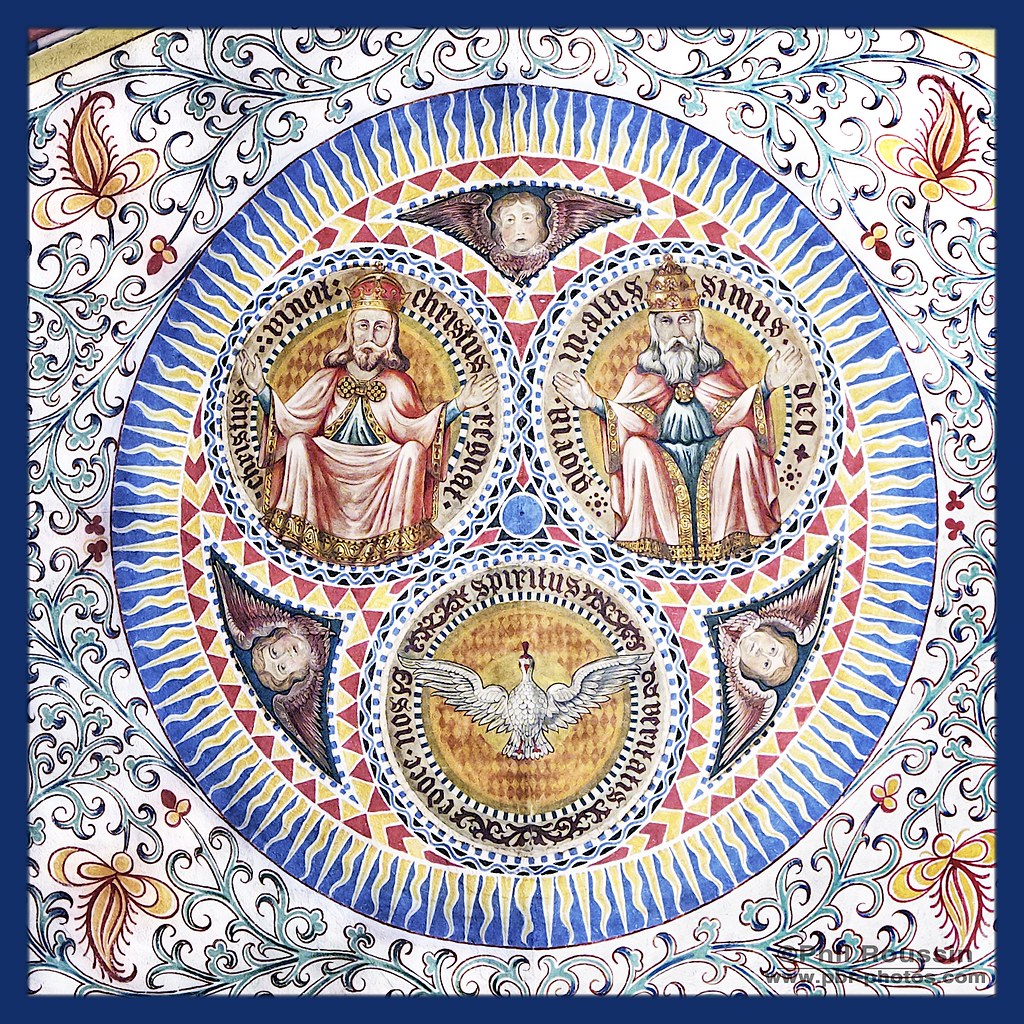 |
| "Christus Vineit" by Phil Roussin, on Flickr |
Isaiah 6:1–8
Romans 8:12–17
John 3:1–17
Now there was a Pharisee named Nicodemus, a leader of the Jews. He came to Jesus by night and said to him, "Rabbi, we know that you are a teacher who has come from God; for no one can do these signs that you do apart from the presence of God." Jesus answered him, "Very truly, I tell you, no one can see the kingdom of God without being born from above." Nicodemus said to him, "How can anyone be born after having grown old? Can one enter a second time into the mother's womb and be born?" Jesus answered, "Very truly, I tell you, no one can enter the kingdom of God without being born of water and Spirit. What is born of the flesh is flesh, and what is born of the Spirit is spirit. Do not be astonished that I said to you, 'You must be born from above.' The wind blows where it chooses, and you hear the sound of it, but you do not know where it comes from or where it goes. So it is with everyone who is born of the Spirit." Nicodemus said to him, "How can these things be?" Jesus answered him, "Are you a teacher of Israel, and yet you do not understand these things?
Very truly, I tell you, we speak of what we know and testify to what we have seen; yet you do not receive our testimony. If I have told you about earthly things and you do not believe, how can you believe if I tell you about heavenly things? No one has ascended into heaven except the one who descended from heaven, the Son of Man. And just as Moses lifted up the serpent in the wilderness, so must the Son of Man be lifted up, that whoever believes in him may have eternal life.
For God so loved the world that he gave his only Son, so that everyone who believes in him may not perish but may have eternal life.Indeed, God did not send the Son into the world to condemn the world, but in order that the world might be saved through him.
--
Friday night, I was jolted awake by the sound of a loud, unidentified crash from somewhere in the house. I shot out of bed and down the dark staircase to figure out what the cats had knocked over. I looked in living room: nothing. Study: nothing. Downstairs bathroom: nothing. Kitchen: nothing. Dining room: nothing. Back up the stairs I went. Upstairs bathroom? Ah, there it was. A basket full of nail polish bottles and assorted extra toiletries, that usually lived on a shelf above the sink, dumped over and scattered across the floor. I scooped everything back into the basket - nothing was broken, thank goodness! - and staggered back to bed. My heart was still pounding. I looked at the clock: 4:27 a.m.
I laid back down, pulled the covers up to my chin....and, nothing. No heavy eyes, no drowsy face, no sleepy limbs. I was wide awake. And inexplicably anxious.
You've all been there, right? Awake in the middle of the night, feeling every anxiety, every worry, thinking about everything that you wish you could forget and everything that you can't afford to forget, all at once. It is in the middle of the night that we feel most certain that our prayers have been lost, and when we also feel most certain that we have no other option but to keep praying.
It is in the dark middle of the night that I often find myself thinking about my dad, replaying over and over again his last days and moments in the hospital, as if there were anything I could do now to have changed the outcome.
It is in the dark middle of the night that I try to reason with the universe in order that I might make any sense of tragedies that shake our community. Tragedies like freak accidents that claim the lives of loved ones, or the dark and fear and inner demons that could drive a terribly young person to take his own life.
It is in the dark middle of the night that I worry about everything that is beyond my power to fix or to understand.
It is in the dark middle of the night that I have no patience for mystery. Insomnia makes me a chaser of reason, rationality, and control.
The same might be said of poor Nicodemus. He is a chaser of reason, of understanding, and I wonder if Nicodemus comes to Jesus by night because he too was already lying in bed awake, struggling with all of the mysteries of the universe, struggling with his own doubts, struggling with impossible questions that need answers.
Nicodemus gets out of bed, and comes to Jesus. They have this conversation that goes in circles, all about the work of the Spirit to rebirth and recreate hearts, and about the work of God in Christ to save the world and not to condemn it.
But dear Nicodemus, bless his heart, can’t wrap his head around all of it. He can’t for the life of him figure out the mechanics of rebirth, or what on earth Jesus means when he talks about being born of the Spirit, and even this business of a God who loves and a God who dies and a God who brings eternal life is a puzzler for him. Nicodemus tries to figure out the inner workings of God and gets stuck in mystery instead. He leaves with more questions than he started with.
Which is pretty much what happens to us every time we try to find answers for this mysterious thing called the Trinity. A word, of course, that Jesus doesn’t use, and a word that never shows up in the Bible, but a word that describes the very Biblical phenomenon of a God who exists and acts as Father and Son and Spirit.
Questions abound. How is God simultaneously three and one? How can God exist in three persons, but we still say that we are monotheists, worshiping only one God? How is God different than merely a shape-shifter? What is the heavenly “division of labor” and which person of God - Father, Son, Spirit - is responsible for which divine tasks?
Let's be honest, there is no "figuring out" the Trinity. Many have tried, many have failed. Heresies abound! In fact, over dinner earlier this week, Pastor Chad jokingly asked me if I was a risk to preach heresy this weekend, to which I responded that preaching heresy is a risk I take every single week, not just on Holy Trinity Sunday!
But very seriously, you'll never hear me claim to understand the Trinity. Because I don’t. Even Martin Luther himself, preaching on Holy Trinity Sunday in 1522, conceded that the best thing you can say about the mystery of the Trinity is that you don't understand it: "We cling to the Scriptures, those passages which testify of the Trinity of God, and we say: I know very well that in God there are the Father, the Son and the Holy Spirit; but how they can be one I do not know, neither should I know it."
I might not understand the Trinity, but I understand dark sleepless nights. And I understand grief. And I understand that our souls constantly need to keep making the choice for hope and against despair. And I think the Trinity might have something to say about this.
Because having a God who exists as three means that we have a God who has experienced everything that there is to experience. God as Creator, Redeemer, Sustainer has the divine ability to hold together all creativity, need, hope, suffering, and salvation. There is no dark night, no creative moment, no mystery or question or joy or confusion, on earth or in heaven, that God-in-three-persons has not already experienced, loved, and redeemed.
But more than that, at the heart of our faith is the cross. And at that pivotal moment when Christ died to destroy death, the whole Trinity was at work. While God in Christ faced death head-on, God the Creator took on the work of grief, God the Spirit made space to do the work of hope and resurrection. Because the Godhead is three-in-one, God didn't die alone on the cross, God didn't grieve alone in heaven, and God didn't lose hope.
And when you put all three of these truths together, you find the whole work of salvation; a mystery as expansive as Isaiah's smoky, terrifying vision of God filling the temple, and yet it is a comfort as dear to us as a father's tender touch.
Paul writes, "When we cry, 'Abba! Father!' it is that very Spirit bearing witness with our spirit that we are children of God, and if children, then heirs, heirs of God and joint heirs with Christ — if, in fact, we suffer with him so that we may also be glorified with him."
Yes, even as we cry "Holy, holy, holy" to a God bigger than we can fathom, we also cry "Abba! Father!" to the one who loves us and claims us, and carries us through our sufferings to the glorious promise of our salvation.
And so in our sleepless nights, in our dark nights of the soul, no matter what mysteries we face, no matter what anxieties plague us, no matter what feeble prayers we raise, no matter how out of control or fearful we feel, the Trinity reminds us that God is bigger than all of it. And God has been through all of it. And God will redeem all of it.
The God who fills the temple is the God who fills the earth, who is Creator and Redeemer and Life-Giving Spirit, who is so huge that there is no place on earth or in heaven, in our heads or in our heart, where God is not present.
Madeleine L'Engle says, “I will have nothing to do with a God who cares only occasionally. I need a God who is with us always, everywhere, in the deepest depths as well as the highest heights. It is when things go wrong, when good things do not happen, when our prayers seem to have been lost, that God is most present. We do not need the sheltering wings when things go smoothly. We are closest to God in the darkness, stumbling along blindly.”
Brothers and sisters, I do not know what your darkness is right now, whether you feel a few casual doubts or whether you wrestle with the very meaning of your life itself. But I do know when we, with Nicodemus, stumble along blindly under cover of night, we do not stumble to our doom; rather, we stumble blindly into the waiting arms of Christ. I know that in the waking hours of the night, when we reach out into the darkness, we do not reach out in vain; rather, we brush fingertips against the hem of God’s kingly robe, which stretches like a blanket over all creation. I know that when we face deepest darkness and long for sheltering wings, we do not go unembraced; rather, God pours upon us water and Spirit, flooding us with assurance of our baptisms, drenching us in the promise of God’s presence, cradling us in the reassuring and persistent flow of all love and rebirth and hope.
The Trinity is an eternal mystery. But it is proof for us that God is able - and willing - to reconcile all things to himself, no matter how painful or contradictory those things may be. The Trinity is assurance for us that we are yet children of light, even when we sit in darkness. For God loves the world. Christ saves the world. The Spirit breathes rebirth into the world. Even in the middle of the night, there is hope.
Let us pray.
God of the Heavens,
keeper of the stars,
Lord of the darkest, most remote places
of the universe,
the one who hovered and breathed life,
and the Creator of every living thing:
Be our salvation, our comfort,
our hope, for you are holy and righteous,
your words are true
and your light dispels all darkness.
Glory to the Almighty God,
Sun of Righteousness
and Breath of Life.
Amen.
(prayer by Thomas Turner; posted on everdayLiturgy)
 |
| Kelly Renee Gissendaner with the theologian Jürgen Moltmann in 2011, when she completed a prison theology program. Credit Ann Borden/Emory University; photo from New York Times |
Genesis 17:1–7, 15–16
When Abram was ninety-nine years old, the LORD appeared to Abram, and said to him, "I am God Almighty; walk before me, and be blameless. 2And I will make my covenant between me and you, and will make you exceedingly numerous." 3Then Abram fell on his face; and God said to him, 4"As for me, this is my covenant with you: You shall be the ancestor of a multitude of nations. 5No longer shall your name be Abram, but your name shall be Abraham; for I have made you the ancestor of a multitude of nations. 6I will make you exceedingly fruitful; and I will make nations of you, and kings shall come from you. 7I will establish my covenant between me and you, and your offspring after you throughout their generations, for an everlasting covenant, to be God to you and to your offspring after you. 15God said to Abraham, "As for Sarai your wife, you shall not call her Sarai, but Sarah shall be her name. 16I will bless her, and moreover I will give you a son by her. I will bless her, and she shall give rise to nations; kings of peoples shall come from her."
Romans 4:13–25
13For the promise that he would inherit the world did not come to Abraham or to his descendants through the law but through the righteousness of faith. 14If it is the adherents of the law who are to be the heirs, faith is null and the promise is void. 15For the law brings wrath; but where there is no law, neither is there violation. 16For this reason it depends on faith, in order that the promise may rest on grace and be guaranteed to all his descendants, not only to the adherents of the law but also to those who share the faith of Abraham (for he is the father of all of us, 17as it is written, "I have made you the father of many nations") — in the presence of the God in whom he believed, who gives life to the dead and calls into existence the things that do not exist. 18Hoping against hope, he believed that he would become "the father of many nations," according to what was said, "So numerous shall your descendants be." 19He did not weaken in faith when he considered his own body, which was already as good as dead (for he was about a hundred years old), or when he considered the barrenness of Sarah's womb. 20No distrust made him waver concerning the promise of God, but he grew strong in his faith as he gave glory to God, 21being fully convinced that God was able to do what he had promised. 22Therefore his faith "was reckoned to him as righteousness." 23Now the words, "it was reckoned to him," were written not for his sake alone, 24but for ours also. It will be reckoned to us who believe in him who raised Jesus our Lord from the dead, 25who was handed over to death for our trespasses and was raised for our justification.
Mark 8:31–38
31Then [Jesus] began to teach them that the Son of Man must undergo great suffering, and be rejected by the elders, the chief priests, and the scribes, and be killed, and after three days rise again. 32He said all this quite openly. And Peter took him aside and began to rebuke him. 33But turning and looking at his disciples, he rebuked Peter and said, "Get behind me, Satan! For you are setting your mind not on divine things but on human things." 34He called the crowd with his disciples, and said to them, "If any want to become my followers, let them deny themselves and take up their cross and follow me. 35For those who want to save their life will lose it, and those who lose their life for my sake, and for the sake of the gospel, will save it. 36For what will it profit them to gain the whole world and forfeit their life? 37Indeed, what can they give in return for their life? 38Those who are ashamed of me and of my words in this adulterous and sinful generation, of them the Son of Man will also be ashamed when he comes in the glory of his Father with the holy angels."
---
There are times that you sit down with the lectionary and can think of a million different directions to preach. And then there are times when you don't have any clear idea, and so you pray - beg, even - for the Holy Spirit to show up. The problem is that sometimes, when you beg, the Holy Spirit indeed shows up...and you sort of wish she hadn't.
Today is one of those days. I'm sure that if I hadn't begged for the Spirit's inspiration, I would have preached some bland but nice sermon about God's covenant promise with Abraham and about the covenant promise that God makes with us through the cross of Christ. But instead, I prayed for the Holy Spirit.
And in a five-minute span, two things happened.
First, I read anew today’s reading from Paul's letter to the Romans, where he contrasts the judgement of the law with the promise of faith: "The law brings wrath,” he writes, and “for this reason [our inheritance] depends on faith, in order that [God’s] promise may rest on grace and be guaranteed to all his descendants.”
Second, I did a quick check of the news, and tripped face-first over the story of Kelly Renee Gissendaner, someone for whom the wrath of the law and the promise of faith stand in dire opposition.
See, Ms. Gissendaner is a death row inmate in Georgia. She was sent to prison in 1998 for orchestrating the murder of her husband at the hands of her boyfriend. Earlier this week, her final petition for clemency was denied by the Georgia board of parole, and she is scheduled to be executed by lethal injection this Monday (tomorrow).
In 2010, Ms. Gissendaner joined some of her fellow inmates in a year-long theology course, run by Atlanta-area divinity schools and universities. She became a dedicated student of theology, passionately devouring works by the likes of Dietrich Bonhoeffer, Rowan Williams, and Jurgen Moltmann. As it turned out, Ms. Gissendaner's theology professor was friends with Professor Moltmann. If you aren't quite up on your contemporary theologians, Jurgenn Moltmann is a biggie. He's eighty-something years old and his works are pretty much required reading at all seminaries and divinity schools. With nothing to lose, Ms. Gissendaner asked her teacher whether it might be okay for her to write to him, thanking him for his writings, which had so moved and inspired her. The two became unlikely pen pals, sharing their faith and their insights with one another. Professor Moltmann even offered a commencement address for Ms. Gissendaner and the ten other inmates who were graduating the year-long theology course.
Ms. Gissendaner continued her theology studies even after the program ended, and has kept up her friendship with Professor Moltmann. She has leaned on her ever-deepening faith to sustain her through these last years in prison, and now into these last few days of her life. She has served as spiritual advisor and counselor to other women in prison with her. She has admitted to the brutal and broken circumstances of her crime. She has prayed and confessed and become a sign of the mercy of God. She has turned to God with her moments of trust and moments of doubt and moments of anger. And now, she looks to God as the giver of resurrection and life as she stares her own mortality squarely in the face.
Jesus says, "If any want to become my followers, let them deny themselves and take up their cross and follow me. For those who want to save their life will lose it, and those who lose their life for my sake, and for the sake of the gospel, will save it. For what will it profit them to gain the whole world and forfeit their life? Indeed, what can they give in return for their life?"
Yes, Jesus says, the value of life is infinite, incomprehensible. So what does it profit any one of us to gain the whole world, and in the meantime, lose our lives? What is the cost of losing a life, either outside the law or at the hands of the law? What does it profit any one of us to be arbitrator of life and death? In the grand scheme of things, knowing that none of us will escape the cost of death, what is the true value of our lives, and where does that value come from?
Jesus, being no stranger to human life, human suffering, and human death, is also no stranger to being handed a life sentence. I have to believe that these words about the way of the cross are, at least in part, born out of the terror and grief of staring down his own untimely death at the hands of an empire, a law, and a people who will fail him.
We, as humans, routinely, spectacularly fail one another. Abraham and Sarah had failed one another in their childless old age. Peter had failed Jesus in a moment of weakness (and would continue to do so). Kelly Renee Gissendaner, by her actions, failed herself and her boyfriend and her husband and the social contract. And parole boards and prosecutors and judges and juries have now failed her. Someday, we, too, will be failed by our systems and structures, and ultimately, by our mortal bodies themselves.
The threat of death makes us honest, I think. Makes us see more clearly what really matters. Makes us more desperate to imagine a future with hope. Makes us more concerned with finding a word of promise to leave for those who will come after us.
This word of promise doesn't come from laws or institutions or human logic. Friends, our justice system will not save us. Neither will any attempts at vigilante justice. Neither capitalism nor Congress, banks nor universities, hospitals nor public servants will be able to guarantee us health, happiness, and life.
But Abraham and Sarah's story, the fervent and effective witness of Peter and Paul and all the apostles, and the very resurrection of Christ serve as reminders to us that the promise of God is an unbreakable promise for a future, and a future with hope, no matter how unlikely it seems. A future that is bigger than we are, a future that does not depend upon fallible human hands and hearts. A future of reconciliation and mercy and beautiful justice that God is ushering in despite all of our best attempts to mess it up.
My heart grieves, it breaks, for Kelly Renee Gissendaner. And for all criminals on death row. It breaks for their friends and peers and for their jailers. It breaks for lawyers and for parole boards and judges and juries. My heart breaks for the victims of violent crimes and their families and friends and supporters. I mean...my heart breaks for a lot of things. Basically, it breaks for all the ways that the laws of this world, written and unwritten, miss the mark in securing a hopeful future for all of our weary world.
The antidote to our grieving, breaking hearts? It is to lose ourselves in faith; to be absorbed by the divine light who gave us life; to put down the cross of anxiety or fear and to take up the cross of Christ; to be willing to lose everything that we might, at the mouth of the empty tomb, gain back everything we hoped for and more. Christ's resurrection is our unshakable assurance of God's promises fulfilled, of the perfect completion of the covenant that God makes with each of us.
When we set our minds on these divine things, rather than on human things, we will see that, though none of us is righteous by our own means, we yet receive righteousness reckoned to us by faith. And whenever and however our mortal lives are taken from us, it is by our faith in the gospel that we - and even Kelly - will yet receive life everlasting.
In the words of the aforementioned Jurgen Moltmann, from his work, Theology of Hope:
Faith…becomes itself a contradiction to the world of death. That is why faith, wherever it develops into hope, causes not rest but unrest, not patience but impatience. It does not calm the unquiet heart, but is itself this unquiet heart in man. Those who hope in Christ can no longer put up with reality as it is, but begin to suffer under it, to contradict it. Peace with God means conflict with the world, for the goad of the promised future stabs inexorably into the flesh of every unfulfilled present.The promise of God for us and for all creation is permanently marked on each and every one of us, in that oil-drawn cross on our foreheads, given to us in baptism. The oil may have long faded away, but the cross marks us forever. It remains our assurance of hope, but is also stands as a testament to our calling.
May we bear God's hope into the world in many and various ways, but specifically as we, the baptized, take seriously our vocation: To live among God's faithful people; to hear the word of God and share in the Lord's supper; to proclaim the good news of God in Christ in word and deed; to serve all people, following the example of Jesus; and perhaps most importantly in our current world, to work for justice and peace in all the world; not peace as the world gives, but peace according to the compassion of Christ.
I pray today for you and for me, that God would raise up in our hearts a fire for justice and an tenderness toward all creation. I pray that we might not fear, but be bold in our proclamation that God's foolishness is wiser than human wisdom, and God's promise of hope is deeper than human ambition. I pray for Kelly and those who love her. I pray for her murdered husband and all who love him. I pray that we, as a society, continue to question and struggle and seek ways to protect and preserve life. I pray that each of us, driven by our faith, will anticipate God's risen and restored future, and work to bring about glimmers of that light-filled kingdom, however imperfectly.
We pray, come, Holy Spirit, come. Live in us. Move in us. Breathe in us. Challenge us. And send us out as signs of hope, symbols of peace, living witnesses to Christ, our savior, our redeemer, and the life of the world.
Amen.
Amazing Peace: A Christmas Poem
by Dr. Maya Angelou
Thunder rumbles in the mountain passes
And lightning rattles the eaves of our houses.
Flood waters await us in our avenues.
Snow falls upon snow, falls upon snow to avalanche
Over unprotected villages.
The sky slips low and grey and threatening.
We question ourselves.
What have we done to so affront nature?
We worry God.
Are you there? Are you there really?
Does the covenant you made with us still hold?
Into this climate of fear and apprehension, Christmas enters,
Streaming lights of joy, ringing bells of hope
And singing carols of forgiveness high up in the bright air.
The world is encouraged to come away from rancor,
Come the way of friendship.
It is the Glad Season.
Thunder ebbs to silence and lightning sleeps quietly in the corner.
Flood waters recede into memory.
Snow becomes a yielding cushion to aid us
As we make our way to higher ground.
Hope is born again in the faces of children
It rides on the shoulders of our aged as they walk into their sunsets.
Hope spreads around the earth. Brightening all things,
Even hate which crouches breeding in dark corridors.
In our joy, we think we hear a whisper.
At first it is too soft. Then only half heard.
We listen carefully as it gathers strength.
We hear a sweetness.
The word is Peace.
It is loud now. It is louder.
Louder than the explosion of bombs.
We tremble at the sound. We are thrilled by its presence.
It is what we have hungered for.
Not just the absence of war. But, true Peace.
A harmony of spirit, a comfort of courtesies.
Security for our beloveds and their beloveds.
We clap hands and welcome the Peace of Christmas.
We beckon this good season to wait a while with us.
We, Baptist and Buddhist, Methodist and Muslim, say come.
Peace.
Come and fill us and our world with your majesty.
We, the Jew and the Jainist, the Catholic and the Confucian,
Implore you, to stay a while with us.
So we may learn by your shimmering light
How to look beyond complexion and see community.
It is Christmas time, a halting of hate time.
On this platform of peace, we can create a language
To translate ourselves to ourselves and to each other.
At this Holy Instant, we celebrate the Birth of Jesus Christ
Into the great religions of the world.
We jubilate the precious advent of trust.
We shout with glorious tongues at the coming of hope.
All the earth's tribes loosen their voices
To celebrate the promise of Peace.
We, Angels and Mortal's, Believers and Non-Believers,
Look heavenward and speak the word aloud.
Peace. We look at our world and speak the word aloud.
Peace. We look at each other, then into ourselves
And we say without shyness or apology or hesitation.
Peace, My Brother.
Peace, My Sister.
Peace, My Soul.
by Dr. Maya Angelou
Thunder rumbles in the mountain passes
And lightning rattles the eaves of our houses.
Flood waters await us in our avenues.
Snow falls upon snow, falls upon snow to avalanche
Over unprotected villages.
The sky slips low and grey and threatening.
We question ourselves.
What have we done to so affront nature?
We worry God.
Are you there? Are you there really?
Does the covenant you made with us still hold?
Into this climate of fear and apprehension, Christmas enters,
Streaming lights of joy, ringing bells of hope
And singing carols of forgiveness high up in the bright air.
The world is encouraged to come away from rancor,
Come the way of friendship.
It is the Glad Season.
Thunder ebbs to silence and lightning sleeps quietly in the corner.
Flood waters recede into memory.
Snow becomes a yielding cushion to aid us
As we make our way to higher ground.
Hope is born again in the faces of children
It rides on the shoulders of our aged as they walk into their sunsets.
Hope spreads around the earth. Brightening all things,
Even hate which crouches breeding in dark corridors.
In our joy, we think we hear a whisper.
At first it is too soft. Then only half heard.
We listen carefully as it gathers strength.
We hear a sweetness.
The word is Peace.
It is loud now. It is louder.
Louder than the explosion of bombs.
We tremble at the sound. We are thrilled by its presence.
It is what we have hungered for.
Not just the absence of war. But, true Peace.
A harmony of spirit, a comfort of courtesies.
Security for our beloveds and their beloveds.
We clap hands and welcome the Peace of Christmas.
We beckon this good season to wait a while with us.
We, Baptist and Buddhist, Methodist and Muslim, say come.
Peace.
Come and fill us and our world with your majesty.
We, the Jew and the Jainist, the Catholic and the Confucian,
Implore you, to stay a while with us.
So we may learn by your shimmering light
How to look beyond complexion and see community.
It is Christmas time, a halting of hate time.
On this platform of peace, we can create a language
To translate ourselves to ourselves and to each other.
At this Holy Instant, we celebrate the Birth of Jesus Christ
Into the great religions of the world.
We jubilate the precious advent of trust.
We shout with glorious tongues at the coming of hope.
All the earth's tribes loosen their voices
To celebrate the promise of Peace.
We, Angels and Mortal's, Believers and Non-Believers,
Look heavenward and speak the word aloud.
Peace. We look at our world and speak the word aloud.
Peace. We look at each other, then into ourselves
And we say without shyness or apology or hesitation.
Peace, My Brother.
Peace, My Sister.
Peace, My Soul.
Luke 2:1-20
In those days a decree went out from Emperor Augustus that all the world should be registered. This was the first registration and was taken while Quirinius was governor of Syria. All went to their own towns to be registered. Joseph also went from the town of Nazareth in Galilee to Judea, to the city of David called Bethlehem, because he was descended from the house and family of David. He went to be registered with Mary, to whom he was engaged and who was expecting a child. While they were there, the time came for her to deliver her child. And she gave birth to her firstborn son and wrapped him in bands of cloth, and laid him in a manger, because there was no place for them in the inn.
In that region there were shepherds living in the fields, keeping watch over their flock by night. Then an angel of the Lord stood before them, and the glory of the Lord shone around them, and they were terrified. But the angel said to them, ‘Do not be afraid; for see—I am bringing you good news of great joy for all the people: to you is born this day in the city of David a Saviour, who is the Messiah, the Lord. This will be a sign for you: you will find a child wrapped in bands of cloth and lying in a manger.’ And suddenly there was with the angel a multitude of the heavenly host, praising God and saying,
‘Glory to God in the highest heaven,
and on earth peace among those whom he favors!’
When the angels had left them and gone into heaven, the shepherds said to one another, ‘Let us go now to Bethlehem and see this thing that has taken place, which the Lord has made known to us.’ So they went with haste and found Mary and Joseph, and the child lying in the manger. When they saw this, they made known what had been told them about this child; and all who heard it were amazed at what the shepherds told them. But Mary treasured all these words and pondered them in her heart. The shepherds returned, glorifying and praising God for all they had heard and seen, as it had been told them.
First Coming
by Madeleine L’Engle
He did not wait till the world was ready,
till men and nations were at peace.
He came when the Heavens were unsteady,
and prisoners cried out for release.
He did not wait for the perfect time.
He came when the need was deep and great.
He dined with sinners in all their grime,
turned water into wine. He did not wait
till hearts were pure. In joy he came
to a tarnished world of sin and doubt.
To a world like ours, of anguished shame
he came, and his Light would not go out.
He came to a world which did not mesh,
to heal its tangles, shield its scorn.
In the mystery of the Word made Flesh
the Maker of the stars was born.
We cannot wait till the world is sane
to raise our songs with joyful voice,
for to share our grief, to touch our pain,
He came with Love: Rejoice! Rejoice!
by Madeleine L’Engle
He did not wait till the world was ready,
till men and nations were at peace.
He came when the Heavens were unsteady,
and prisoners cried out for release.
He did not wait for the perfect time.
He came when the need was deep and great.
He dined with sinners in all their grime,
turned water into wine. He did not wait
till hearts were pure. In joy he came
to a tarnished world of sin and doubt.
To a world like ours, of anguished shame
he came, and his Light would not go out.
He came to a world which did not mesh,
to heal its tangles, shield its scorn.
In the mystery of the Word made Flesh
the Maker of the stars was born.
We cannot wait till the world is sane
to raise our songs with joyful voice,
for to share our grief, to touch our pain,
He came with Love: Rejoice! Rejoice!
It's a little early in Advent for a "Jesus is born" lullaby, but I heard this for the first time yesterday and was completely captivated by it. It is sweet, charming, peaceful, and just enough surprising to keep you listening intently. It is a rocking song of the salvation for which we wait: Christ will come soon, as a little bitty baby, to save us, to lighten our dark world with a bright star.
Motets: Lullay
Text by Carol Barratt
Music by Karl Jenkins
Lullay, lullay.
Lullay, my loved one, so peaceful, so small,
sleep while the world awakes.
Under the bright star just over your stall,
safe as the morning breaks.
Lullay, lullay.
Jesu, so peaceful, asleep in the hay,
rest till you hear us call.
One day you'll carry our sorrows away,
soon you will save us all.
Jesu, Jesu.
Lullay, my loved one, so peaceful, so small,
rest till the storms pass by.
Lullay, lullay.
Motets: Lullay
Text by Carol Barratt
Music by Karl Jenkins
Lullay, lullay.
Lullay, my loved one, so peaceful, so small,
sleep while the world awakes.
Under the bright star just over your stall,
safe as the morning breaks.
Lullay, lullay.
Jesu, so peaceful, asleep in the hay,
rest till you hear us call.
One day you'll carry our sorrows away,
soon you will save us all.
Jesu, Jesu.
Lullay, my loved one, so peaceful, so small,
rest till the storms pass by.
Lullay, lullay.
 |
| "All saints' Day - Kära farmor" by Capelson, on Flickr |
"They live on, those giants of our childhood. They manage to even take death in their stride. Death may take them, but it can never take our relationship with them. However else they still live on, they still live on in us. Memory is more than looking back to a time gone by; it is looking into another kind of time altogether. A time where everything that was continues to be – and grows and changes with the life that is in us.
The people we loved and who loved us; for good or for ill, taught us things. Dead though they may be, as we come to understand them in new ways, it is though they come to understand us – and we come to understand ourselves – in new ways too.
Who knows what 'the communion of saints' means, but surely it means that these people we once knew are not just voices that have ceased to speak. They are saints because though them the power and richness of life not only touched us once, but continues to touch us still.
They have their business to get on with – moving 'from strength to strength' – whatever that means. We might imagine ourselves on a fading shore as they move on to whatever shore may await them. But they carry with them something of us, as we do of them. And so, to think of them is not only to remember how they used to be. It is, in some way, to see and hear them as they now are.
If they had things to say to us then, they have things to say to us now – as we have to them. And the things now spoken may not be what they once were."
-Frederick Buechner
 |
| "peace" by Olympia, on Flickr |
John 20:19-22
When it was evening on that day, the first day of the week, and the doors of the house where the disciples had met were locked for fear of the Jews, Jesus came and stood among them and said, "Peace be with you." After he said this, he showed them his hands and his side. Then the disciples rejoiced when they saw the Lord. Jesus said to them again, "Peace be with you. As the Father has sent me, so I send you." When he had said this, he breathed on them and said to them, "Receive the Holy Spirit."
 |
| "Julian of Norwich" by Robert Lentz, posted by Kittredge Cherry, on Flickr |
John 10:1-10
Jesus said, "Very truly, I tell you, anyone who does not enter the sheepfold by the gate but climbs in by another way is a thief and a bandit. The one who enters by the gate is the shepherd of the sheep. The gatekeeper opens the gate for him, and the sheep hear his voice. He calls his own sheep by name and leads them out. When he has brought out all his own, he goes ahead of them, and the sheep follow him because they know his voice. They will not follow a stranger, but they will run from him because they do not know the voice of strangers." Jesus used this figure of speech with them, but they did not understand what he was saying to them.
So again Jesus said to them, "Very truly, I tell you, I am the gate for the sheep. All who came before me are thieves and bandits; but the sheep did not listen to them. I am the gate. Whoever enters by me will be saved, and will come in and go out and find pasture. The thief comes only to steal and kill and destroy. I came that they may have life, and have it abundantly."
---
Growing up, my dad directed the church choir and my mom sang in it. This meant that every Sunday, my sisters and I would sit by my dad in the front row of the sanctuary, in clear sight of the choir loft and my mom’s watchful eye.
Most of the time, I think, we were pretty well behaved. We’d draw pictures on the yellow children’s bulletins, follow along with the hymns, try discreetly to open up our loud velcro wallets to fish out some change for the offering plate. But there were times that we squirmed. That we squabbled. That we poked each other or got the giggles. And in those moments, from behind the organ in the second row of the choir came the mom cough.
Ahem-AHEM.
I could pick that sound out of a lineup.
The whole congregation could cough and clear their voices for the entire service and we’d never notice, but one stifled cough from mom’s throat, and our eyes would dart up to meet her gaze, and we’d sit up a little straighter in our seats, and we’d quit whatever mischief we were dabbling in.
It’s a peculiar thing, isn’t it, that we know so well the sound of our mother’s voice?
Sam is just getting old enough that he recognizes my voice and responds to it differently than other people’s voices. He can be perfectly content in someone else’s arms, but when he hears my voice, he turns to find me, and lurches toward me, and when I take him, he buries his face in my neck, happy to be reunited with the voice that he knows best.
Jesus says, “I am the good shepherd. My sheep follow me because they know my voice.”
Like a child recognizing the voice of his mother, like a sheep recognizing the voice of its shepherd, we follow Jesus by the sound of his voice. Christ, the shepherd and guardian of our souls calls to us in a voice so recognizable that we can pick it out of the crowd.
And what a crowd it is.
We are pummeled with voices, aren't we? Every day, voices of all sorts call out to us and demand things of us.
We hear voices on the radio and on television and through the internet. Some of these voices speak truth, and some speak untruth, and some speak fear, and some speak hyperbole. We hear voices in politics, and some speak fact, and some speak dissent, and some speak out of both sides of their mouths, and some speak persuasion rather than common good. We hear our own voices, and some speak confidence, and some speak self-reliance, and some speak self-doubt, and some speak self-criticism.
We hear good advice and bad advice, voices that challenge us and voices that enable us. I think about Job, and how his friends all had something to say to him in the midst of his suffering, and the way that their advice always seemed good on the surface, but ended up lacking.
So in the middle of such a cacophony of voices, how do we pick out the voice of Jesus?
Well, for starters, we can remember that the voice of Jesus has particular power to heal and to restore life.
During Lent and Easter, we have read three different stories that reveal the power of Jesus' voice. He speaks words of healing to the man born blind, and his sight is restored. He calls to Lazarus, dead in the tomb, who responds to the sound of Jesus' voice by emerging from the tomb, alive. And he speaks Mary's name in the garden, and it is only at the sound of his voice that she sees him not as the gardner, but as her risen savior.
Jesus' voice is one that always speaks with healing and life-giving power.
Jesus is the one who says, “I am the bread of life. I am the light of the world. I am the way, the truth, and the life. I am the vine and you are the branches. I am the resurrection and the life. I came that they may have life, and have it abundantly.”
There's an early American hymn that says:
His voice as the sound of the dulcimer sweet, is heard through the shadows of death.Yes, we can know Jesus' voice by the things he says, by his enduring words of life piercing the shadows of death, by his sweet song of righteousness and salvation, by the sound of eternal and abundant life. Whenever we hear voices that speak forgiveness and mercy, voices that speak peace and life abundant, these are the voice of Jesus.
The cedars of Lebanon bow at His feet, the air is perfumed with His breath.
His lips as the fountain of righteousness flow, that water the garden of grace,
From which their salvation the people shall know, and bask in the smile of His face.
Love sits in His eyelids and scatters delight thro’ all the bright regions on high.
Their faces the Cherubim veil in His sight and tremble with fullness of joy.
He looks and ten thousands of angels rejoice, And myriads wait for His word.
He speaks and eternity, filled with His voice, re-echoes the praise of her Lord.
And the heart of the matter is that the reason we can listen for and recognize Jesus' powerful voice of healing and new life is because we are in relationship with him and he with us.
I know the sound of my mother's mom-cough, and Sam knows the sound of my voice, and we all know the sound of those dear to us, be they parents or spouses or kindred spirits, living or dead, because of the relationship that we have with each other. Knowing one another deeply, and being deeply known.
Jesus says “I know my own and my own know me.”
What a beautiful statement. It's a two-way relationship. One of the failings of popular Christianity is that it overemphasizes our responsibility to come to know Jesus, and underemphasizes Jesus' desire to know us.
But think about the woman at the well, who had no inclination whatsoever that she was speaking to Jesus, and didn't particularly care about knowing the stranger sitting next to her. Jesus was the one seeking relationship. She is amazed that this man, "knew everything I've ever done." Jesus is the first to initiate relationship, and only later does she respond in faith.
Jesus seeks to know us even as he seeks for us to know him. And out of this relationship, we are able, more and more, to hear his voice ringing through this earth, in every song of hope and healing.
The medieval mystic Julian of Norwich describes God in Christ as the one as intimately connected to us as the very mothers who gave us birth:
[Christ] is our Mother in human nature in our essential creation. In Him we are grounded and rooted, and he is our mother in mercy by taking on our fleshliness....In Mother Christ, we benefit and grow, and in mercy He redeems and restores us....This fair lovely word 'mother' is so sweet and so kind in itself, that it can not truly be said of anyone nor to anyone except of Him and to Him who is true Mother of life and of all. To the quality of motherhood belongs natural love, wisdom, and knowledge - and this is God. (from Revelations of Divine Love)As a mother protects and nurtures her children, so Christ protects and nurtures us whom he loves.
Jesus has put himself into relationship with us, into close kindred with humankind, having himself put on human flesh. He joins us to himself in baptism, in our dying and rising through those waters. He joins us to himself in the bread and wine, as we do something as scandalous and intimate as taking his very body into our hands and hearts and bodies.
He is the good shepherd, leading us beside still waters, along paths of righteousness, through the darkest valleys, to eternal and abundant life. He knows us and we know him, and we hear his voice calling to us, saying to each of us,
"Come to me, all you who are weary and carrying heavy burdens, and I will give you rest. I am your resurrection, and I am your abundant life."
Yesterday was a beautiful coming together of images: the caring protection of Jesus the good shepherd, and celebrating mothers and those who provide mothering care. A perfect setting to hear again Bobby McFerrin's work "The 23rd Psalm (dedicated to my mother)," performed here by Cantus.
The Lord is my Shepherd, I have all I need,
She makes me lie down in green meadows,
Beside the still waters She will lead.
She restores my soul, She rights my wrongs,
She leads me in a path of good things,
And fills my heart with songs.
Even though I walk through a dark and dreary land,
There is nothing that can shake me,
She has said She won't forsake me,
I'm in her hand.
She sets a table before me, in the presence of my foes,
She anoints my head with oil,
And my cup overflows.
Surely, surely goodness and kindness will follow me,
All the days of my life,
And I will live in her house,
Forever, forever and ever.
Glory be to our Mother, and Daughter,
And to the Holy of Holies,
As it was in the beginning is now and ever shall be,
World without end. Amen.
The Lord is my Shepherd, I have all I need,
She makes me lie down in green meadows,
Beside the still waters She will lead.
She restores my soul, She rights my wrongs,
She leads me in a path of good things,
And fills my heart with songs.
Even though I walk through a dark and dreary land,
There is nothing that can shake me,
She has said She won't forsake me,
I'm in her hand.
She sets a table before me, in the presence of my foes,
She anoints my head with oil,
And my cup overflows.
Surely, surely goodness and kindness will follow me,
All the days of my life,
And I will live in her house,
Forever, forever and ever.
Glory be to our Mother, and Daughter,
And to the Holy of Holies,
As it was in the beginning is now and ever shall be,
World without end. Amen.
 |
| "star light, star bright" by jeanine.stewart, on Fliickr |
Sure On This Shining Night
by James Agee
Sure on this shining night
Of star made shadows round,
Kindness must watch for me
This side the ground.
The late year lies down the north.
All is healed, all is health.
High summer holds the earth.
Hearts all whole.
Sure on this shining night I weep for wonder wand'ring faralone
Of shadows on the stars.
from Permit Me Voyage published 1934 by Yale University Press
Jesus your coming into the world meant,
the blind received their sight, the lame walked,
the lepers were cleansed, the deaf heard,
the dead were raised, and the poor had good news brought to them.
We pray your coming again means this and more.
We pray it means healing for the land,
Joyous song breaking out everywhere,
Bright colors and deeper hues will be seen everywhere.
Flowing waters will appear where there was once dry beds.
Cool air will ease the furious heat.
We pray your coming will have people being kind and loving to each other.
No more harsh and rude words or violence used.
We pray for that day.
We pray our hearts are being prepared for that day.
Grant us the patience and strength we will need to continue to wait.
Transform our lives in the ways that need to be changed
in order to live in peace with others.
Let us stop judging and criticizing each other,
So that we can love others the way God loves us.
So that as we wait in the meantime we are living
our lives in a way that points the way to you.
Come Lord Jesus come.
--by Abi Carlisle Wilke, posted at RevGalBlogPals
the blind received their sight, the lame walked,
the lepers were cleansed, the deaf heard,
the dead were raised, and the poor had good news brought to them.
We pray your coming again means this and more.
We pray it means healing for the land,
Joyous song breaking out everywhere,
Bright colors and deeper hues will be seen everywhere.
Flowing waters will appear where there was once dry beds.
Cool air will ease the furious heat.
We pray your coming will have people being kind and loving to each other.
No more harsh and rude words or violence used.
We pray for that day.
We pray our hearts are being prepared for that day.
Grant us the patience and strength we will need to continue to wait.
Transform our lives in the ways that need to be changed
in order to live in peace with others.
Let us stop judging and criticizing each other,
So that we can love others the way God loves us.
So that as we wait in the meantime we are living
our lives in a way that points the way to you.
Come Lord Jesus come.
--by Abi Carlisle Wilke, posted at RevGalBlogPals